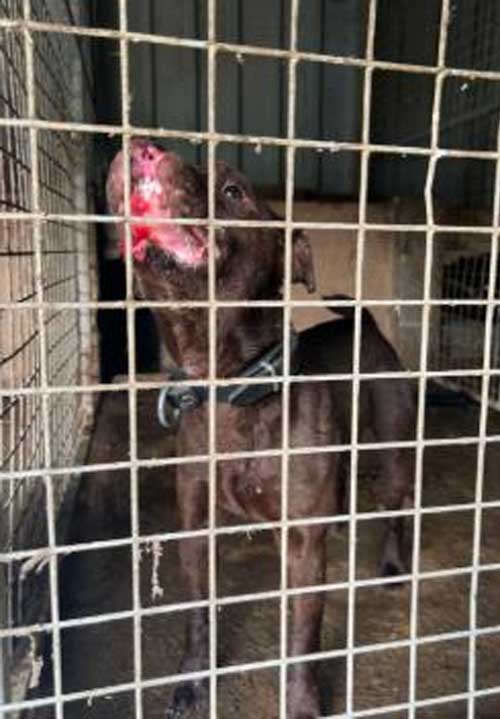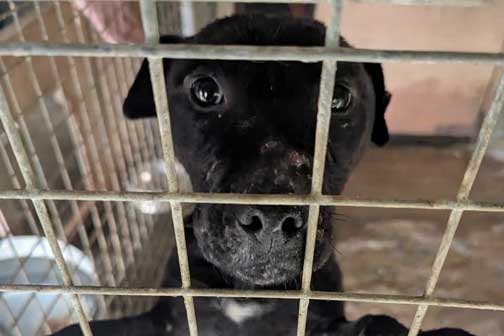
A man whose three Patterdale terriers were found suffering from serious injuries — including one dog whose wounds had caused chronic pain for at least two weeks — has been convicted of animal welfare offences.
Rhys Ebenezer, of Llangeitho, near Tregaron in Ceredigion, admitted four offences under the Animal Welfare Act following an RSPCA investigation into the treatment of his dogs.
RSPCA officers Holly Brown and Darryl Thomas attended Ebenezer’s property on 29 September 2025 after receiving information that injured dogs were being housed in kennels.
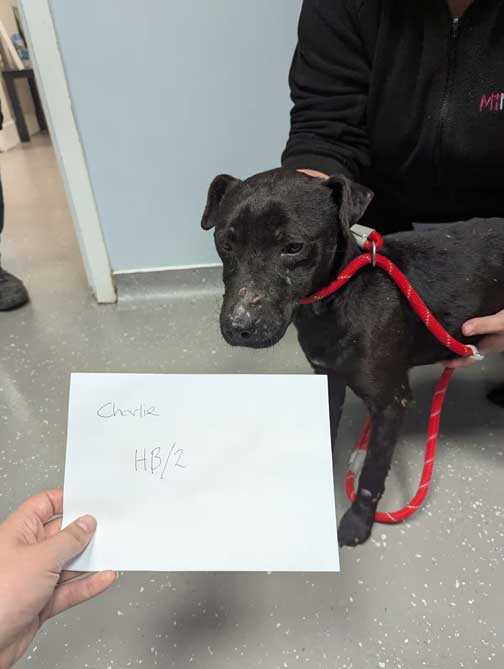
Their attention was immediately drawn to two Patterdale terriers, four-year-old Charlie and two-year-old Twig.
Twig was found curled up in her bed and was described as lethargic and subdued. She had a large blue bandage around her front right leg.
Officers were told Twig had been injured during a fight with another dog, Champ, through the bars of their kennels.
Charlie was also causing serious concern.
Although alert and active, he was underweight, with his ribs clearly visible and his waist noticeably drawn in.
More disturbing were the numerous scars and wounds covering his body. Some appeared relatively recent while others were at different stages of healing.
Particular concern was raised about wounds to the inside of his front and back legs.
A veterinary examination concluded the injuries were of different ages, with some estimated to be around two weeks old and others approximately a week old.
The vet found that the wounds were inconsistent with the explanation that they had resulted from ratting.
Investigators then learned that a third dog, Champ, had already been put to sleep.
Ebenezer used an excavator to recover Champ’s body from where it had been buried in a remote mountain field so it could be examined as part of the investigation.
The extent of the dead dog’s injuries was shocking.
An RSPCA officer described injuries resembling de-gloving to both sides of Champ’s lower jaw, while part of his nose was also missing.
A veterinary surgeon subsequently identified injuries to Champ’s chin, nostril and ear.
Crucially, the vet determined that the severe injury to his chin had been sustained at least two weeks before he was euthanised and would have caused him chronic pain and discomfort.
Veterinary evidence concluded that all three dogs — Twig, Charlie and Champ — had suffered as a result of their injuries.
Ebenezer had initially attributed severe facial and body scarring on the dogs to “ratting”, but veterinary evidence did not support that explanation.
When the case came before the court, mitigation included Ebenezer’s lack of previous convictions, his early guilty pleas and positive character references from his employer.
He received an 18-week custodial sentence, suspended for two years, together with a six-month curfew and 15 rehabilitation activity requirement days.
He was also barred from travelling abroad for 12 months and ordered to pay £6,410.92 in costs plus a £154 victim surcharge.
Most significantly, Ebenezer was disqualified from keeping all animals for 10 years, with the ban running until May 2036.
The case followed an investigation and prosecution brought by the RSPCA.