
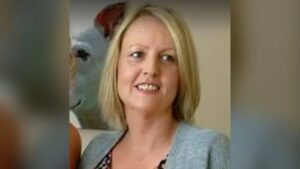
Stepmother jailed after years of horrific abuse left schoolgirl with broken bones and more than 50 bruises
A woman who subjected her stepdaughter to years of physical and psychological abuse from the age of six was jailed after a court heard how the child was beaten with household objects, force-fed revolting mixtures and threatened into hiding what was happening to her.
Bridget Kenneally, from Co Cork, was sentenced to two years in prison after pleading guilty to assault causing harm.
The abuse began after Kenneally entered a relationship with the girl’s father in 2005. What initially appeared to be a caring relationship developed into years of cruelty which continued throughout much of the child’s upbringing.
The girl was repeatedly assaulted using objects including a fire poker, belts, vacuum cleaner poles and spatulas.
Her injuries became so serious that she required hospital treatment on a number of occasions.
Following one particularly severe incident in 2008, she spent a week in hospital with a serious head injury. Medical examinations documented more than 50 bruises across her body.
On another occasion, Kenneally twisted the child’s hand with such force that her thumb was broken.
But alongside the violence came efforts to conceal what had happened.
The youngster was pressured into giving false explanations to medical professionals about how she had been injured. She was instructed to claim one injury happened while she was in the garden and to blame a head injury on an incident at an amusement park she had visited weeks earlier.
The abuse was not limited to beatings.
The court heard the child was subjected to sustained psychological cruelty and was threatened with death if she revealed what was happening. She was also warned that speaking out could result in her being separated from her sister.
As another form of punishment, she was made to consume a mixture containing hot spices, salt, pepper, mustard, chilli powder and vinegar.
The experience had such a lasting effect that certain smells and tastes continued to trigger reactions long after she had escaped the abusive environment.
Kenneally was said to have singled the girl out because she was the smallest and easiest target in the household.
While Kenneally’s own children were allowed greater freedom to socialise, the girl and her sister were kept at home to carry out chores and cleaning.
To those outside the home, the youngster could appear confident, outgoing and caring. Behind closed doors, however, she lived in fear of what punishment might come next.
Concerns about her welfare were raised over the years, including by her school principal.
After her 2008 hospital admission, she was required to attend weekly appointments with a GP, where the extent of her injuries was documented.
Kenneally was informally interviewed in 2016 and arrested the following year after a formal complaint was made.
She eventually pleaded guilty to assault causing harm in relation to an offence committed during October 2009 at Kenny’s Lane in Youghal, Co Cork.
The woman she abused, by then an adult, spoke about the long-term consequences of what she had endured as a child, including anxiety, flashbacks and an exaggerated startle response.
She said that while physical scars remained, the psychological impact had proved even harder to overcome.
Kenneally’s barrister, Patrick O’Riordan, told the court she had no previous convictions and had paid €5,000 compensation. Her defence also referred to mental health difficulties and said she had been struggling to cope while caring for six children.
An apology was offered on Kenneally’s behalf, although the woman she abused said she did not believe the remorse was genuine.
Judge Sean O’Donnabhain considered psychological reports and described what had happened as a prolonged period of systemic abuse against a vulnerable child.
The court heard of broken bones, hospital admissions, repeated beatings and forced feeding throughout the girl’s childhood.
Kenneally was ultimately sentenced to two years behind bars.
After the case, the survivor encouraged other people experiencing abuse to speak out, explaining that she had remained silent for years before finally seeing the woman responsible brought before a court.
She said the abuse had begun when she was just six and continued until she was 16.
Now an adult, she spoke of finally being able to move forward with her life after spending much of her childhood living in fear.